Document Digitization Services
PTFS provides secure, rare and fragile and high-volume document digitization for all types of materials.
Successfully Serving These and Many Other Organizations.









PTFS offers comprehensive digitization services that transform physical documents and media into easily accessible digital formats, enhancing efficiency, access, and data management. Their cutting-edge technology ensures high-quality digital conversions, making information retrieval seamless and secure.
- Coordination of the transfer and shipping of physical assets.
- Inventory, catalog and store the material in a centralized, secure and temperature/humidity-controlled environment.
- Building metadata and searchable web-based catalog.
- Conversion to electronic format based on FADGI 3-star or 4-star standards.
- Loading digital assets and associated metadata to a repository such as Knowvation to allow instand, high performance access
- Optional returning of physical assets and/or secure, monitored destruction in our Top Secret facility.
PTFS has maintained a facility clearance with cleared staff since the late 1990’s in our digitization services bureau. We offer services for CUI, PII, PHI and Classified information with the highest sensitivity in our Federal Government.
With extensive experience in digitizing and processing government records, including projects exceeding NARA and Library of Congress digitization standards, we are experts in Records Management policies and digital submission requirements such as FADGI and executive order M-23-07. To meet M-23-07 compliance, hardcopy records must be digitized. Our Digitization Services Bureau offers a comprehensive suite of digitization services to ensure seamless conversion.
Our experience in digitizing and processing government records includes work for NARA, and we are well-versed in RM policies, digital submission requirements like FADGI and executive order M-23-07. To comply with M-23-07, hardcopy records must be converted to a digital format. Our Digitization Services Bureau provides the full range of digitization services.
Digitization Services
PTFS provides secure, rare and fragile and high-volume scanning services for all types of materials.
Information management is an increasingly paperless practice. Digitization takes content to new platforms and new heights. From extending the life of ancient manuscripts and preserving original audio interviews to converting engineering blueprints and ensuring the security of declassification procedures, our skilled staff and state-of-the-art equipment will help you achieve your goals.
Key Processes and Technology in Our Digitization Services
- Advanced technologies used in PTFS’s digitization process (e.g., fuzzy search, document intelligence, dynamic redaction).
- Categorizing and extracting information.
- Highlight dynamic redaction and its importance in protecting sensitive information.
- Data accuracy and integrity.
- OCR for accurate text recognition and automated quality checks.
- Security measures implemented to protect digitized documents.
- Encryption, access controls, and regular security audits.
Our Document Digitization Processes

PTFS leverages state-of-the-art hardware, software and process technology to enable optimized searching, retrieval and management of documents, while meeting ISO:19005 Standards for Archiving. Our secure Digitization Service Bureau meets NARA compliance regulations and is environmentally controlled to ensure document stability.
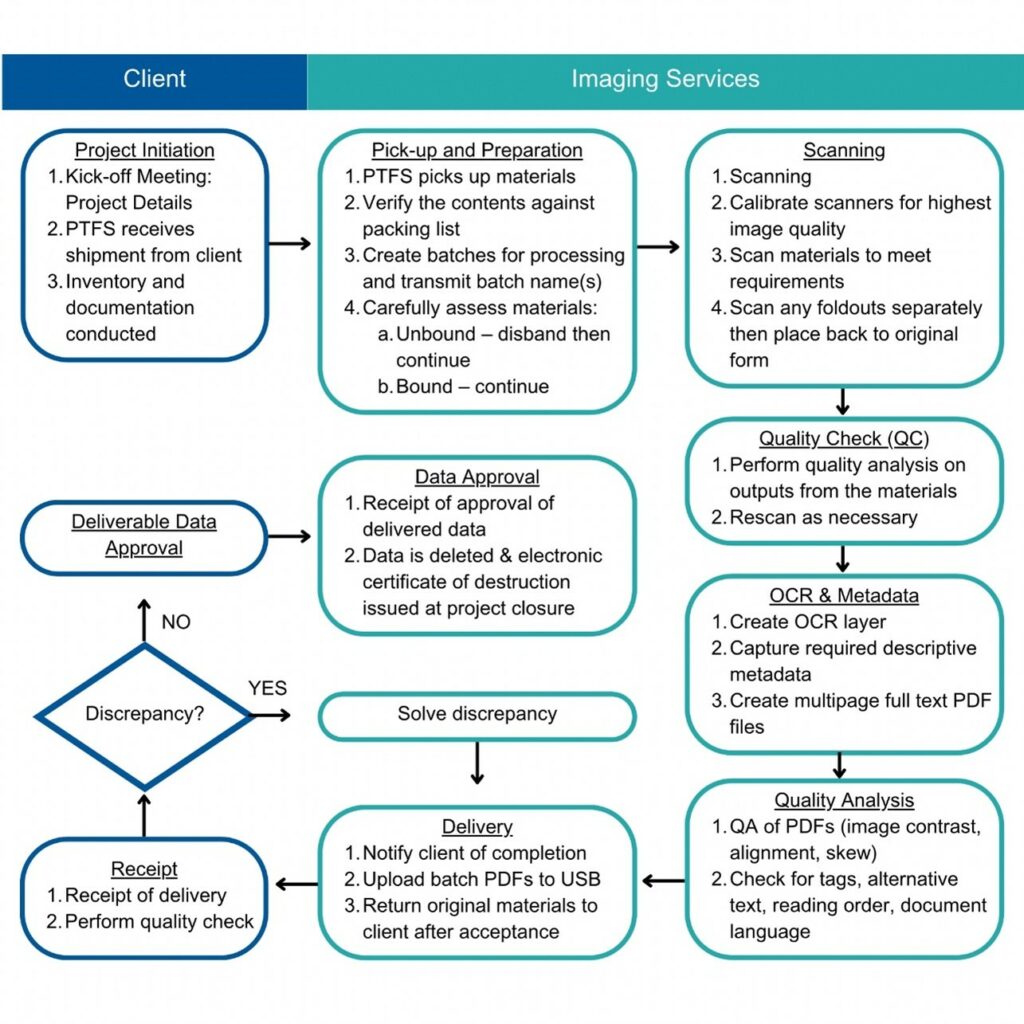
Below is an overview of our typical digitization project process, including QA checkpoints and real-time monitoring by our customers by accessing Knowvation during the scanning project.
Digitization Capabilities
Notable Feature & Description
Document Scanning
We utilize state-of-the-art scanners to digitally capture a wide array of paper documents, historical records, including manuscripts, books, maps, photographs, microfilm/microfiche, and more. Our scanning process ensures high-resolution image capture and minimal distortion or alterations to the original documents.
Metadata Creation and Indexing
We create comprehensive metadata and indexing systems that allow for efficient search and retrieval of digitized historical records. Our experts utilize industry-standard protocols to ensure accurate and consistent metadata creation, preserving the integrity and authenticity of each record
Conservation and Preservation
We understand the importance of preserving historical records for future generations. Our team employs best practices for document handling, storage, and conservation, ensuring the longevity of both physical and digital formats. We adhere to stringent guidelines to safeguard against damage, loss, or decay during the digitization process.
Optical Character Recognition (OCR)
Our technology employs OCR to recognize and extract text from images or scanned documents accurately. Our advanced OCR technology converts scanned historical records into searchable text documents, enabling keyword-based searching within the content itself. This greatly enhances accessibility and ease of use for researchers, historians, and the public.
Quality Assurance
Our quality assurance (QA) practices are meticulous, guaranteeing accurate and true-to-original digitized historical records. Our dedicated team conducts rigorous quality checks at various stages to identify and rectify any anomalies, ultimately delivering high-quality results to our clients.
Intelligent Document Analysis
This service analyzes documents to identify content structures, including tables, headers, footers, and paragraphs, ensuring accurate conversion and optimal layout.
Batch Processing
Users can convert multiple documents simultaneously, enhancing efficiency and saving time when dealing with large volumes of documents.
Paper Documents
We have decades of experience a wide range of paper scanning machines, including high volume autofeed, flatbed and planetary scanners.
Photographs and Slides
Conversion of black and white or color prints, slides or negatives to web-ready and high-resolution digital photographs.
Microfilm and Microfiche
High-resolution microfilm, microfiche, and aperture card scanners capture images at a variety of DPI settings.
Books and Journals
Planetary and FADGI compliant V-Cradle scanners produce digital images without touching the surface of fragile materials.
Engineering Drawings
Large format scanners can handle many engineering media types, from standard blueprints to Mylar and Sepia.
Video, Film and Audio
PTFS builds video, film and audio libraries using digital files created from analog source originals.
File Formats
PTFS has extensive experience digitizing and saving converted analog information to a wide variety of digital image file formats.
Optical Character Recognition (OCR)
Using our OCR engine and PTFS best practices, PTFS can increase OCR accuracy and reduce error rates by up to 80% over conventional OCR processes.
Metadata Creation
Pertinent data about the image is keyed by experienced PTFS indexing staff or extracted automatically from forms or client legacy databases.
Section 508 Compliance Post-processing
We employ Optical Character Recognition (OCR) tools to render text within the scanned documents. This process converts text into selectable and searchable content, enhancing accessibility for individuals with disabilities. Additionally, we offer manual verification and label augmentation.
Case Studies and Success Stories
Below are some examples of notable customer projects for notable agencies:
| Customer | Project Name | Project-Specific Experience | ||||||
|---|---|---|---|---|---|---|---|---|
| Images Processed | Packing, transport, and handling of materials | Preparation of Original Materials | Document Scanning | Delivering Digital Master Image Files | Labeling, Cataloging and Collection Building | Digital File Organization or Transformation | ||
| Defense Threat Reduction Agency | Nuclear Test Personnel Review Project | 6M | ✔ | ✔ | ✔ | ✔ | ✔ | ✔ |
| Defense Technical Information Center | Data Warehouse | 5M | ✔ | ✔ | ✔ | ✔ | ✔ | |
| National Oceanic and Atmospheric Administration | Bound and Unbound Document Digitization | 338K | ✔ | ✔ | ✔ | ✔ | ✔ | |
| Contracts and | Digitization of Contract Files for CGD | 113K | ✔ | ✔ | ✔ | ✔ | ✔ | |
| Grants Directorate (LCCG) | ||||||||
| U.S. Army Corps of Engineers, Headquarters/Humphreys | Digitization of bound volumes for USACE HQ/HECSA Library | 72K | ✔ | ✔ | ✔ | ✔ | ✔ | ✔ |
| Engineer Center Support Activity Library | ||||||||
| Naval Explosive Ordnance Division | Classified and Unclassified Document Scanning | 7.5M | ✔ | ✔ | ✔ | ✔ | ✔ | |
| Department of Homeland Security | Secure Personnel File Scanning | 1.7M | ✔ | ✔ | ✔ | ✔ | ✔ | |
| Missile Defense Agency | Scanning for Declassification | 1.5M | ✔ | ✔ | ✔ | ✔ | ✔ | |
| National Geospatial- Intelligence Agency | GeoCard Microfilm Scanning | 11M | ✔ | ✔ | ✔ | ✔ | ||
| Redstone Scientific Information Center | Digitization of Agency Documents | 1M | ✔ | ✔ | ✔ | ✔ | ||
| Internal Revenue Service | TE/GE Microfiche Scanning | 5M | ✔ | ✔ | ✔ | ✔ | ✔ | |
Benefits of Digitization
Digitization lets you leverage all your organization’s content to ensure the most thorough decisions, allow full compliance, and enable accurate reporting can occur.
Creating metadata while migrating legacy content will improve the discovery of links between information in different media formats, increasing accuracy and saving time. Our secure digitization facility meets NARA compliance regulations and is environmentally controlled to ensure document stability.
Efficient Processes
PTFS’s clients receive access to a team expertly using innovative tools. PTFS’s Digitization Specialists efficiently condense mountains of paper into gigabytes of data, while qualified imaging staff convert photographic slides and microfilm into searchable online portfolios. Our experienced program managers are ready to field unique requests and complete content conversion projects of any size to meet commercial best practices.
Our Staff
- 150+ combined years of scanning experience
- 70+ combined years of scanning and digitization management experience
- Onsite Certified Document Imaging Architects (CDIAs)
Our Hardware
Scanner, Capability & Specifications
Mekel Mach VII
High Speed Microfiche Scanning
200 dpi – 600 dpi Optical Resolution. 200 dpi – 600 dpi Output Resolution. Fiche formats: all standard aperture card and fiche types including standard or long jackets, COM, AB Dick, Ultra Fiche and Microx. Film (Images) types: 16 mm or 35 mm, combo 16 mm / 35 mm, simplex or duplex, positive or negative, Diazo, Silver, Vesicular, Cine/Comic mode. Output options: Black-and-White, Grayscale (8 bit), and Color (24 bit). Output File Formats: TIFF bitonal G3/G4, TIFF uncompressed, Multi-page TIFF, JPEG, Multi-page PDF, PDF/A and JPEG 2000. Quantum software platform for image processing, frame detection, title bar/full-fiche imaging, indexing and output.
High Performance Paper Scanning
200 dpi – 600 dpi Optical Resolution. 75 dpi – 1200 dpi Output Resolution. 750-page auto document feeder. Output Options: Black-and-White (1 bit), Grayscale (8 bit), and Color (24 bit). 120 ppm/240 ppm ADF scanning. Output File Formats: TIFF bitonal G3/G4, TIFF uncompressed, Multi-page TIFF, JPEG, Multi-page PDF, PDF/A and JPEG 2000. Paper Weight: 9 to 110 lb. paper. Document Size for Feeder: (2 in. x 2 in.) to (11.7 in. x 34 in.). FADGI compliance 1-star to 3-star level performance.
I2S CopiBook V-Shape Scanner V-A1 XD
V-Shape Planetary Book Scanner
High productivity V-shape/cradle planetary book scanner, 100 dpi – 600 dpi Optical Resolution, 100 dpi – 1000 dpi Output Resolution. Scan mode: color, grayscale and black & white. File format outputs: TIFF uncompressed, TIFF G4, JPEG, JP2, BMP, PDF, PNG, and DNG. Software: LIMB Capture Software / 64 bit. FADGI compliance 1-star to 4-star level performance.
Engineering Roll-Feed Scanner for miscellaneous oversized documents, Computer Printouts/Ribbon Paper
60” width scan unlimited length, 508 dpi optical res., 9600 dpi max. res., 48-bit color 16-bit grayscale, 3.0 inch/sec. in 24-bit RGB color, 12.0 inch/sec. in Grayscale/Mono
Best Practice Expertise
PTFS’ Certified Document Imaging Architects (CDIA) have years of experience digitizing in accordance with standards and best practices developed by the National Archives and Records Administration (NARA), Library of Congress, and Federal Agencies Digital Guidelines Initiative (FADGI) ensuring high quality output. While this benefits all of our customers, our Government clientele are particularly appreciative since they are often required to meet these standards. In addition, our in-depth experience in handling sensitive materials offers customers a high level of confidence that their declassification and content conversion projects are being carried out by a practiced and trusted business partner.
Digitization Experience
Clients come to PTFS with original copies of their materials because they know we can preserve mission-critical content. We are acutely aware of the importance of handling sensitive information and we take the responsibility very seriously. From maintaining page breaks when migrating legacy content to embedding more than 100 metadata tags, the best end user experience is always our goal.
Handling Fragile or Oversized Documents
PTFS has a long history of handling and digitizing legacy assets, primarily fragile or large-format paper items, as well as bound assets. These have ranged from index card-sized papers (2” x 4”) to engineering drawings/blueprints (22” x 34” to 34” x 44”). PTFS digitization personnel have been trained to assess and handle these materials to ensure that the asset can be digitized without damaging the original hardcopy while ensuring that the entirety of the asset can be scanned to produce the best quality image capture. These assets are scanned utilizing a flatbed, planetary or v-cradle scanner to be digitized in a nondestructive manner and never scanned using an automatic document feeder scanner.
During the document preparation phase, PTFS inserts target sheets to indicate to the Scanner Operators where foldouts, maps or large format materials are located within a title. These are primarily items that are larger than 11” x 17” in size. This permits those items to be scanned separately during production and ensures that they are inserted into their appropriate location within the title prior to the creation of the deliverable output files. Items such as fragile pages, foldouts, maps or large format materials identified and flagged during document preparation are processed in parallel with the pages that can be scanned using ADF or flatbed (between 2” x 2” and 11” x 17” sized pages) scanners. The target sheets inserted are scanned in the appropriate sequential location in the title, which in turn is used to insert the scanned images of the fragile pages, foldouts, maps or large format items during the QC step of the digitization workflow.
For materials that are fragile or in poor condition and may be damaged even with the use of a book cradle at scan time, PTFS annotates their condition and notifies the customer for guidance as to how to proceed with those affected items. Bound assets are handled in a nondestructive manner if requirements do not permit these items to be disbound or disassembled for scanning. In these cases, the bound materials are scanned in a manner that does not damage the original hardcopy utilizing the appropriate planetary or v-cradle capable scanning platform.
Quality Control Processes and Techniques
PTFS reviews, inspects, an evaluates images during production and prior to their delivery to electronically by:
- Selecting the appropriate scanner that meets the guidelines for image capture while not damaging the original physical items.
- Selecting the appropriate scanner that meets the FADGI 3-star performance level requirement.
- Ensuring scanners and associated systems are calibrated and maintained for accurate and quality image capture.
- Verification of accurate output of FADGI 3-star Dice Target images.
- Use of DICE Device and Object Level targets.
- Use of Golden Thread Analysis software from Image Science Associates to validate 3-star output.
- Selecting and documenting the appropriate scanning settings (i.e., resolution, brightness, contrast, filters, etc.) to meet PWS specifications Performing a QC check on up to 100% of the images to verify items including:
- File format, compression and file type.
- Capture of the complete page.
- Proper image reading orientation.
- Checking for image distortions and taking corrective action to eliminate/minimize impact.
- Identifying, reporting and discussing images that cannot be captured to meet quality benchmark requirements.
- Post-scan processing or image enhancement in accordance with organization requirements.
- Rescanning or reworking images that did not pass the QC check.
- Verification of appropriate image crop and de-skew.
- Verification of image distortion, page alignment, polarity.
- Other image requirements such as tone, color, aimpoints, noise, saturation, sharpness, file naming, creation of appropriate documentation for submission with each delivery
- Confirmation of 1:1 capture of content from hardcopy.
- Confirmation of the return of the original hardcopy to their original sequential order, reassembled if necessary, to their original containers.
- Verifying embedding of technical, descriptive metadata and other metadata as required.
- QA and upload of deliverable data for transmission or upload to RIM systems, with accurate labeling and chain of custody documentation.
- Creating and collecting appropriate documentation for submission.
- Accurate disposition of hardcopy originals post digitization based on the type and schedule of the record.
Records Management Assessment Service
Step 1
Assessment of IT Systems, Data Inventories, Data Maps, and Records Inventories and Repositories
We evaluate the supporting IT systems including hardware and software, data inventories, data maps, and records inventories and repositories. Specific activities include:
- Inventorying and assessing current IT systems used for creating records and records management, including Outlook, Oracle, Salesforce, DocuSign, Tableau, ServiceNow, SharePoint, M365, and Microsoft Power Platform. Identify and analyze all software/hardware interfaces and interdependencies.
- Developing comprehensive data inventories and data maps to catalog all records and information repositories at orgs.
- Identifying and documenting APIs and integration points between different IT systems and records repositories.
- Producing a detailed inventory and assessment report of IT systems, data inventories, data maps, and records repositories, with recommendations for system enhancements and integrations.
Step 2
Identification of Records for Digitization
We identify the number of records that must be digitized and managed in compliance with 36 CFR Part 1236. Our methodology includes:
- Developing criteria for identifying records that require digitization based on 36 CFR Part 1236, legal requirements, relevance, capstone approach and operational needs.
- Estimating the volume of records to be digitized and managed under the program.
Our primary deliverable is a report identifying the records to be digitized, including an estimated count and the criteria used for selection.
Step 3
Detailed Analysis of Existing Paper Records
We conduct a detailed analysis of existing paper records, including types, formats, and conditions. The analysis entails:
- Performing a physical and digital inventory of existing paper records.
- Analyzing the types, formats, and conditions of paper records. This analysis helps discover oversized documents and documents that are fragile such as onion skin.
- Identifying preservation needs and challenges related to the digitization process including producing FADGI compliant files.
- Determining required metadata fields that meet NARA standards and requirements and provide requisite functionality for the program.
At the conclusion of the analysis, we produce an analytical report detailing the types, formats, and conditions of existing paper records, with priority recommendations for their digitization and preservation.
Step 4
Assess Handling Sensitive or Confidential Information.
We identify specific requirements for handling sensitive or confidential information during the digitization process:
- Review policies and regulatory requirements for handling sensitive and confidential information.
- Review DoDM 5200.01, Volume 3 for proper handling of classified information.
- Identify records containing sensitive and/or classified information and develop procedures for their secure handling during digitization and electronic storage.
The principal deliverable be a set of procedures and guidelines for securely handling sensitive, confidential and classified information during the digitization process.
Step 5
Develop Recommendations for Digitization Prioritization
We provide recommendations for the order of priority in digitizing records. Activities include:
- Developing criteria for prioritizing records based on legal requirements, relevance, operational needs, and other pertinent factors.
- Ranking records according to the established criteria to determine the order of digitization.
We deliver a prioritized list of records for digitization, with the criteria and rationale used for prioritization.
Step 6
Evaluation of Data Classification and Metadata Standards
We evaluate the efficiency of current data classification and metadata standards:
- Review and assess existing data classification schemas and metadata standards including NARA standards and requirements.
- Identify inconsistencies and areas for improvement.
- Consider AI/ML technologies to improve efficiency and exceed standards.