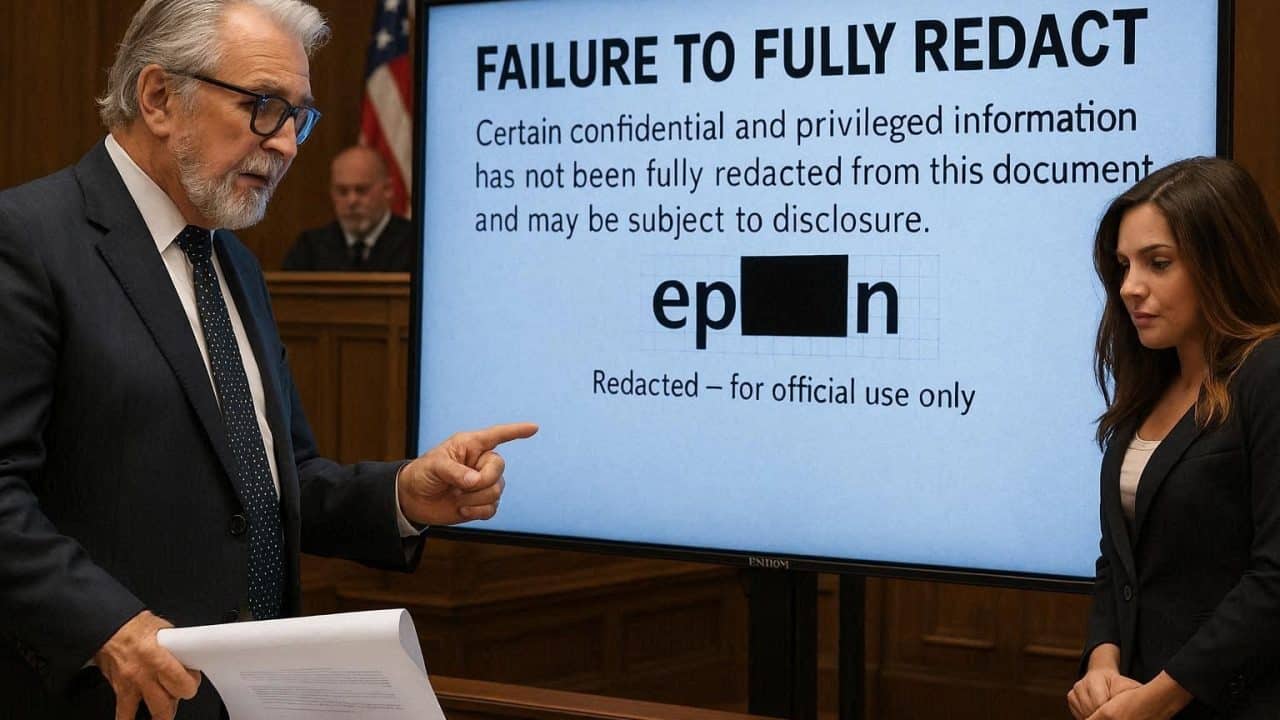
A Comprehensive Guide to Legal Foundations, Technical Standards, and Innovative Solutions with Knowvation
In an era where information transparency clashes with the imperatives of security and privacy, document redaction stands as a critical safeguard. Governments, courts, and organizations routinely handle vast troves of sensitive data, from classified intelligence to personnel records. Redaction ensures that only appropriate information is disclosed, protecting national security, individual privacy, and legal compliance. But what exactly is redaction, why is it legally mandated, and what technical hurdles must be overcome? More importantly, how do advanced tools like PTFS’s Knowvation platform—particularly its Knowvation DX module—streamline this process to meet stringent requirements? This blog post delves into these questions, drawing primarily from PTFS’s resources while grounding the discussion in established government guidelines.
What is Redaction? A High-Level Overview
At its core, redaction is the process of selectively and permanently removing or obscuring sensitive information from a document before its release or distribution. This isn’t just blacking out text with a marker; it’s a meticulous procedure to eliminate data that could compromise security, privacy, or legal protections. In government contexts, redaction often applies to documents under review for public release, such as those requested via the Freedom of Information Act (FOIA) or during declassification processes.
Redaction targets various elements: personally identifiable information (PII) like names, Social Security numbers, or addresses; protected health information (PHI); classified details related to national security; or proprietary data. The goal is to release the “segregable” portions—non-sensitive content—while ensuring the redacted parts are irretrievable. Improper redaction can lead to disastrous leaks, as seen in historical cases where metadata or hidden layers revealed obscured information.
From a practical standpoint, redaction transforms documents into sanitized versions suitable for broader audiences. For instance, a PDF report might have sections blacked out with opaque polygons, accompanied by exemption codes explaining the withholding (e.g., privacy or national security). This balances transparency with protection, fostering public trust in governmental operations.
The Legal Background: Why Redaction is Essential
Redaction’s legal roots trace back to foundational U.S. laws emphasizing information access tempered by exemptions. The Freedom of Information Act (FOIA), enacted in 1966 and amended multiple times, mandates federal agencies to disclose records upon request unless they fall under one of nine exemptions. These include national defense secrets (Exemption 1), personnel privacy (Exemption 6), and law enforcement techniques (Exemption 7). Agencies must redact exempt material and release the rest, a principle known as “segregability.”
Similarly, the Privacy Act of 1974 protects personal data in federal records, requiring redaction of PII to prevent unwarranted invasions of privacy. In judicial settings, Federal Rules of Civil Procedure (Rule 5.2) and Criminal Procedure (Rule 49.1) dictate redacting identifiers like birth dates (to year only), minors’ names (to initials), and financial details (to last four digits) in court filings. Declassification under Executive Order 13526 involves reviewing classified documents, often after 25 years, with redaction applied to withhold ongoing sensitive information.
The National Archives and Records Administration (NARA) oversees declassification, using redaction codes to denote withholdings based on categories like intelligence sources or foreign relations. The E-Government Act of 2002 further emphasizes digital privacy, mandating redaction in electronic records. Non-compliance risks legal challenges, data breaches, or reputational damage. For example, FOIA requires agencies to mark redactions with specific exemptions and indicate the extent of deletions, promoting accountability.
In healthcare and other sectors, laws like HIPAA reinforce PHI redaction. Overall, these frameworks ensure redaction isn’t optional but a legal obligation, adapting to evolving threats like cyber risks.
Technical Requirements: Ensuring Permanent and Secure Redaction
Effective redaction demands more than surface-level edits; it requires robust technical standards to prevent reversal or leakage. Key requirements include:
1. Permanent Removal: Redactions must be irreversible. Superficial methods, like changing text color to white or using digital highlighters, are inadequate as they can be undone by simple tools. Instead, sensitive data—text, images, or metadata—must be excised from all layers of a document. For PDFs, this means removing content from the visible image layer and hidden OCR (Optical Character Recognition) text layer.
2. Sanitization Beyond Redaction: Especially for “born-digital” files (e.g., from Microsoft Office) or digitized scans, sanitization addresses hidden elements. This includes optional PDF objects (e.g., annotations, embedded files), internal structural data (e.g., comments), and steganographic data (hidden within image pixels). Sanitization disrupts potential covert channels, such as by altering pixel values without affecting visuals.
3. Advanced Search and Identification: Tools must employ sophisticated searches—fuzzy logic for OCR errors, natural language processing (NLP) for contextual concepts, Boolean queries, and geospatial filters—to pinpoint sensitive content. Glossaries of “dirty words” (sensitive terms, synonyms, acronyms) automate highlighting, with exemption codes applied.
4. Workflow and Auditing: Redaction processes need integrated workflows for assignment, review, quality control (QC/QA), and auditing. This includes version control to track changes, productivity metrics, and compliance reports. Security features like role-based access (e.g., “need-to-know”) and integration with systems like Active Directory are crucial.
5. File Handling and Compliance Standards: Support for diverse formats (PDFs, images, audio) via OCR on ingest ensures indexability. Outputs should adhere to PDF/A (ISO standard) for archival compliance, embedding metadata without risks. Multilingual and foreign language support is vital for global operations.
6. AI and Automation: Modern requirements incorporate AI for efficiency, such as machine learning to refine sensitive word libraries or custom large language models (LLMs) trained on agency guides for nuanced detection.
Failure to meet these can result in “inadvertent spills,” underscoring the need for validated tools that go beyond basic software like Adobe Acrobat.
Avoiding Irreversible Redaction Errors and Liability
In an era of heightened demands for government transparency, redaction errors continue to undermine trust and cause real harm. High-profile failures demonstrate the risks of manual, outdated processes—especially under tight deadlines and massive volumes.
The most glaring recent example occurred in the Jeffrey Epstein files release. Under the Epstein Files Transparency Act (signed November 2025), the Department of Justice (DOJ) published over 3 million pages, videos, and images starting late 2025 into early 2026. Intended to promote accountability while protecting victims, the effort backfired spectacularly.
Victims’ attorneys reported thousands of redaction failures exposing names, nicknames, email addresses, family details, and even unredacted photos of potentially underage individuals for nearly 100 survivors. Superficial black boxes failed to permanently remove underlying data—allowing easy recovery via copy-paste or basic tools. This “unfolding emergency” retraumatized victims, turning lives “upside down,” per lawyers Brittany Henderson and Brad Edwards. The DOJ withdrew thousands of documents, blamed “technical or human error,” and worked around the clock on corrections—but damage was already done, with irreversible online dissemination.
UN experts condemned the botched redactions as undermining accountability for grave crimes, calling for victim-centered procedures. Other issues included inconsistent over-redaction of non-victims and under-redaction of sensitive info, highlighting manual review limitations in high-volume scenarios.
These lapses echo broader patterns: FOIA responses with incomplete sanitization, court filings leaking metadata, and rushed disclosures failing to scrub hidden layers. Consequences include privacy violations, legal challenges, reputational harm, and eroded public confidence.
The Cure for Large Redaction Projects
Manual methods simply can’t scale reliably. PTFS’s Knowvation DX prevents such disasters through AI-driven human in the loop, permanent redaction—excising content across all layers (visible, OCR, metadata), using NLP and fuzzy searches for accurate detection, applying exemption codes, and providing full audit trails. Proven in government environments, it delivers 10x faster processing with superior accuracy, minimizing human error.
How PTFS’s Knowvation Meets All Federal Requirements
Progressive Technology Federal Systems (PTFS) offers Knowvation, an enterprise content services platform (eCSP) that excels in digital asset management, with Knowvation DX specifically tailored for redaction and declassification. Deployed in over 45 government organizations, including DoD and intelligence agencies, Knowvation DX semi-automates workflows, boosting efficiency while ensuring compliance.
Knowvation DX defines redaction as permanently removing sensitive text, images, and metadata from visible and hidden layers, aligning with legal mandates like FOIA and declassification under Executive Order 13526. It supports exemptions by highlighting content with codes, enabling partial releases. For privacy laws, it identifies and redacts PII/PHI, complying with HIPAA and Privacy Act requirements.
Technically, Knowvation DX exceeds standards through AI-powered features. Its advanced search combines fuzzy pattern recognition (handling OCR errors and misspellings), concept-based NLP (detecting synonyms and contexts), Boolean/exact matches, and geospatial queries. Upon ingest, embedded OCR indexes scanned PDFs, images, and even mobile photos, making them searchable. A sensitive word glossary ingests lists of terms, acronyms, and phrases, automating highlights for review.
The redaction editor uses automated full-text search to mark sensitive areas, allowing manual zones for images or complex elements. Redactions replace content with opaque polygons (black, white, or colored), optionally stamped with exemption codes, ensuring irreversibility across layers. For sanitization, the PDF Sanitizer (Version 1.4) removes optional objects, scrubs internal data, and disrupts steganographic risks by pixel manipulation in future updates—going “considerably further” than NSA guidelines.
Workflows are powered by a flexible built in engine, enabling custom processes without coding: document assignment, analyst review, supervisory oversight, and electronic referrals. Audits generate reports on productivity (up to 10x faster than manual), accuracy, and compliance metrics, retaining instruction sets for recreations or policy changes.
Features like index/document-level security, Active Directory integration, and Section 508 compliance ensure “need-to-know” access and accessibility. It handles over 200 file types, multilingual content, and cloud deployments (e.g., AWS, Govcloud, Secret environments). AI integrations, including custom LLMs and machine learning under SBIR grants, refine detection, reducing false positives/negatives.
Benefits are profound: Agencies report 10x processing speeds and superior accuracy, as noted by retired U.S. Air Force CIO Jim Neighbors: “processing rate that is 10 times faster than manual processing and was also statistically proven to find items we were looking for better than the naked eye.” Costs drop through automation, risks minimize via permanent removal, and adaptability to evolving mandates (e.g., new FOIA rules) is seamless. Knowvation DX’s modular architecture supports scalability for high-volume FOIA/declass projects, proven in rigorous tests.
In essence, Knowvation DX not only meets but elevates redaction standards, transforming a labor-intensive task into an efficient, secure process. For governments grappling with backlogs, it’s a game-changer, ensuring transparency without compromise.
References: Government Sites
– U.S. Department of Justice, Office of Information Policy: https://www.justice.gov/oip
– National Archives and Records Administration: https://www.archives.gov
– FOIA.gov: https://www.foia.gov
– U.S. Courts: https://www.uscourts.gov
– National Institute of Standards and Technology: https://csrc.nist.gov

Leave a Reply