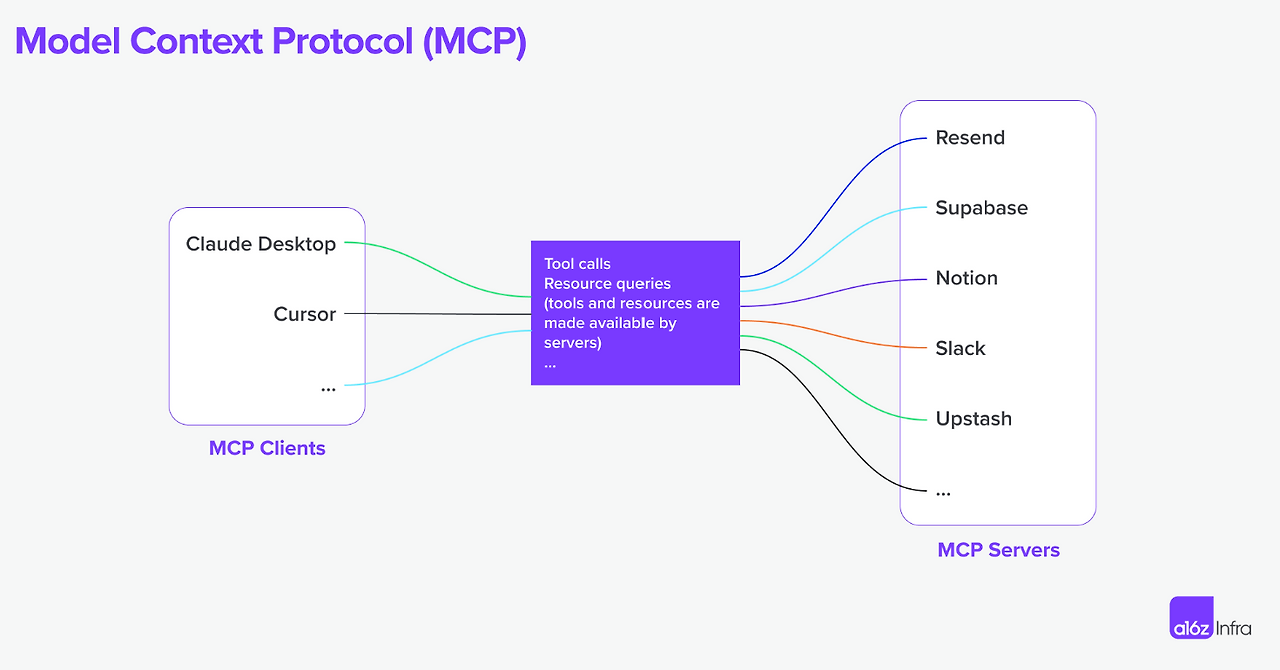
If you ask anyone who has built a federated search system what the hardest part was, the answer is rarely the search itself. It is the connectors. Every system an organization owns speaks its own language, formats its results differently, and enforces its own rules about who can see what. For decades, that meant federated search products succeeded or failed on the size of their connector libraries, and keeping those connectors working as each system changed was a never-ending chore. What makes 2026 different is that this bottleneck is finally loosening, largely thanks to a shared protocol.
That protocol is the Model Context Protocol, usually shortened to MCP. It is an open standard for connecting AI applications to outside systems, first released by Anthropic in 2024 and later handed over to the Agentic AI Foundation, a Linux Foundation fund co-founded by Anthropic, Block, and OpenAI [1]. By the time of that handover, developers were downloading its software kits more than 97 million times a month, and at least 10,000 MCP servers had been set up [1]. Each of those servers is, in effect, a ready-made doorway that any compatible AI tool can knock on. When a software vendor ships its own MCP server, whoever is building a federated search layer no longer has to write that connector at all. It is no coincidence that analysts now point to MCP as one of the main reasons buyers are taking a fresh look at federated tools [2].
The protocol itself grew up considerably this year. Lead maintainer David Soria Parra described the July 28, 2026 specification as the most substantial change since authorization was first added [1]. Its central change sounds technical but has very practical consequences. Earlier versions required a continuous “session” between the AI tool and the server, which made servers awkward to run at scale. The new version drops that requirement, so each request carries everything it needs and can be handled on its own [1]. That means an MCP server can now be run like any ordinary web service, spread across many machines behind a standard load balancer [3]. Routing details are also copied into ordinary web headers, so existing network equipment can direct traffic without having to open up and read every message [1]. For federated search, where a single question might fan out to dozens of sources at once, this is exactly the kind of unglamorous improvement that makes large deployments realistic.
The same release added a way for an AI tool to ask a server what it can do before committing to a full connection, and allowed lists of available capabilities to be cached rather than fetched again every time [3]. Both changes shave time and cost off each federated query, which adds up quickly when software, rather than people, is doing the asking.
The roadmap published in August hints at where things are heading next [3]. One priority is what the maintainers call progressive discovery. They point out that connecting to a server offering a hundred tools forces the AI model to process that entire menu before a user has even asked a question, and that the model tends to choose less well as the menu grows [3]. Their solution is to let a server reveal a small starting set and expose more as the conversation narrows. Anyone familiar with federated search will recognize this as a version of the field’s oldest problem: deciding which sources are worth asking in the first place. Another priority is letting servers push updates to AI tools, through mechanisms such as webhooks, so that clients are not stuck repeatedly checking for new results [3]. That points toward a future in which sources notify AI systems when something relevant changes, rather than waiting to be asked.
These protocol changes are already shaping real products. In August 2026, the security company DataBahn launched a federated search and orchestration platform that lets security teams and their AI agents search every data store they own where it sits, without copying it anywhere [4]. The company’s reasoning is telling. It argued that data volumes have grown so large that pulling everything into one index just to search it is no longer affordable, so the data has to be searched in place [4]. Its AI agents reach those systems through a single governed MCP gateway rather than a tangle of one-off integrations [4].
That story captures the broader pattern neatly. Cheaper storage and specialized tools have scattered organizational data across more places than ever, and open protocols now make it affordable to search across all those fragments. The competitive question for federated search is shifting away from who has the most connectors and toward who can orchestrate them best: picking the right sources, merging their answers sensibly, and doing it all quickly enough to feel instant. Lowering the cost of reaching data, however, raises an obvious and uncomfortable question about who should be allowed to reach it. That is where Part 3 of this series picks up.
Sources
- Jackson, J. (2026, July 23). Model Context Protocol prepares to break with its stateful past. The Register.
- Most, B. (2026, April 8). What Gartner’s Market Guide for Enterprise AI Search Means for Your 2026 Strategy. GoSearch Blog.
- Soria Parra, D., & Delimarsky, D. (2026, August 22). The New MCP Roadmap. Model Context Protocol Blog.
- DataBahn. (2026, August 4). DataBahn Launches Federated Search and Orchestration to Bring Discovery, Context and Investigation to Enterprise Data [Press release].

Leave a Reply