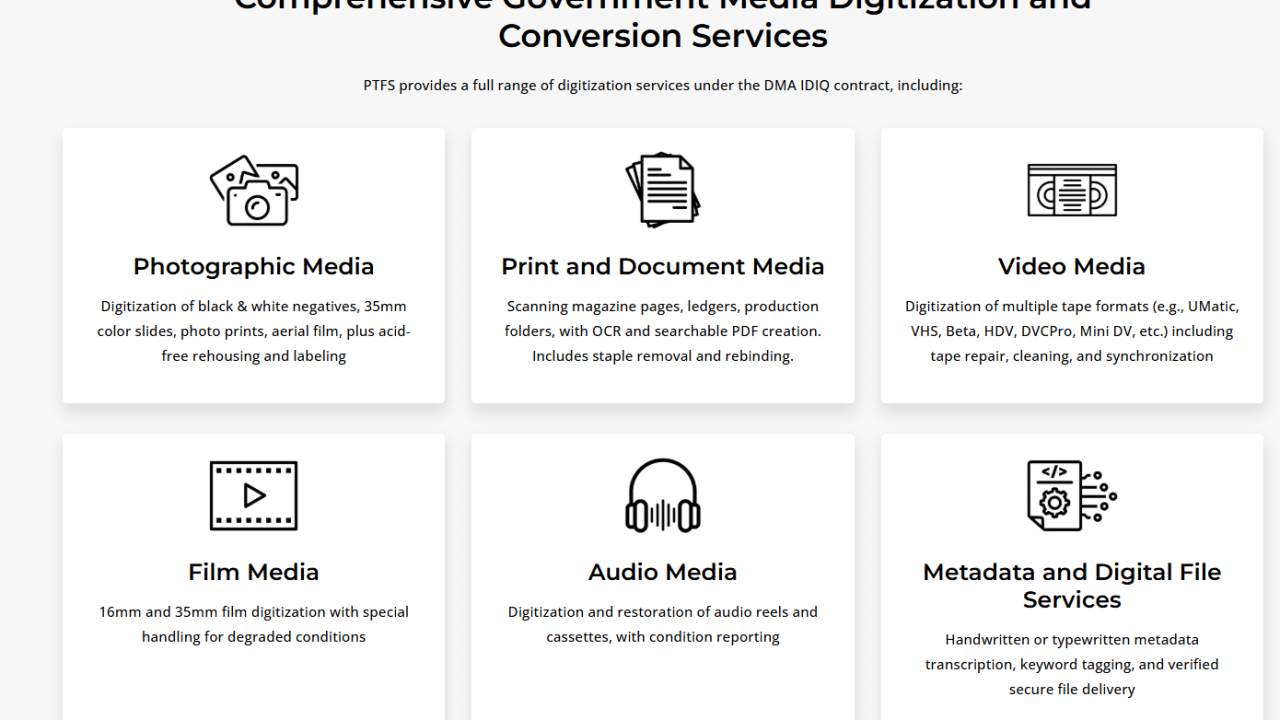
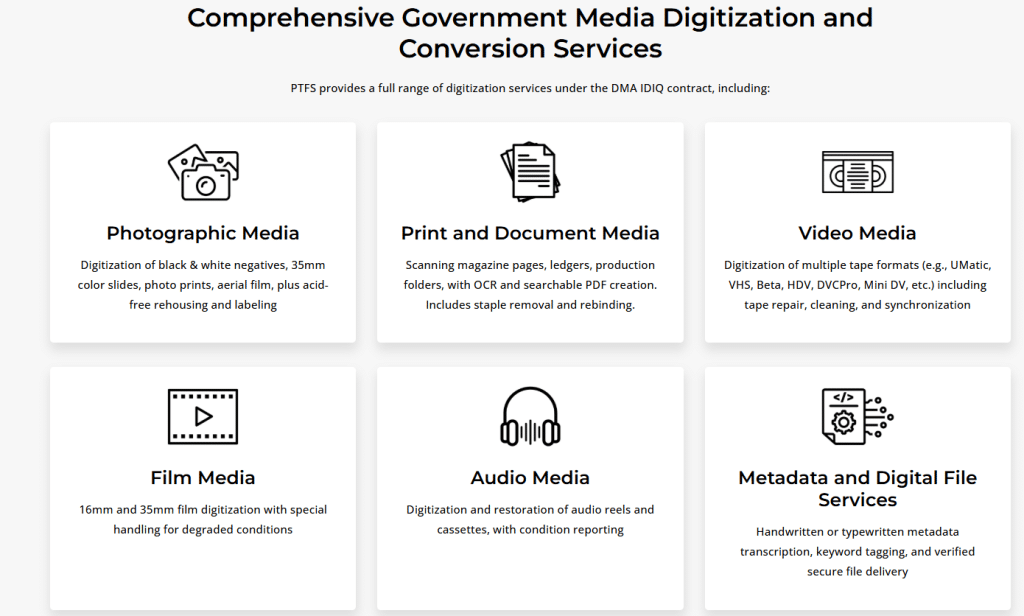
Somewhere in a federal warehouse right now, there’s a box of aerial reconnaissance film from a Cold War-era mission slowly degrading, sitting next to a stack of handwritten ledgers nobody’s touched in years. Multiply that by dozens of agencies and decades of paperwork, and you start to see the scale of a problem most Americans never think about: the government has a lot of stuff, and a shrinking window to save it before it’s gone for good.
That’s the gap a company called PTFS (Progressive Technology Federal Systems) has quietly built a business around. It’s not a household name, but if you’ve ever searched for an old piece of legislation online or pulled up a historical government document from your couch, there’s a decent chance work like theirs made that possible.
Why the Government Relies on Them
First, security. A lot of what needs to be digitized isn’t just old — it’s sensitive or classified. PTFS runs a dedicated digitization facility in Rockville, Maryland, staffed by cleared U.S. citizens, and it has held facility clearance since the late 1990s. When you’re handling Missile Defense Agency archives or Defense Threat Reduction Agency verification records, that’s not optional — it’s the price of entry.
Second, they’ve made themselves easy to hire. PTFS holds an IDIQ contract — that’s “Indefinite Delivery, Indefinite Quantity,” a type of government contract that lets agencies order services against pre-negotiated pricing instead of running a whole new bidding process every time — with the Department of Defense’s Defense Media Activity (DMA). That contract was recently extended, putting PTFS in charge of a Media Digitization Support effort covering everything from presidential libraries to military heritage centers. They’re also resold through Carahsoft, which plugs them into procurement vehicles like NASA’s SEWP program and NASPO ValuePoint — basically giving even more agencies an easy on-ramp to hire them without reinventing the wheel.
Third, and maybe most simply: they’ve done this a lot. PTFS says it’s digitized over 100 million images across more than 110 federal clients, including the Library of Congress, Homeland Security, and the Naval Research Laboratory. Their most visible project is probably GovInfo — the Government Publishing Office’s online repository of more than 60 million federal documents, dating back to the Federalist Papers. It’s the only U.S. federal repository certified as a “trustworthy digital repository” under an international standard called ISO 16363, which is a fairly big deal in archival circles even if it means nothing to most people scrolling through old bills online.
Why it Matters
Because most of the time, this kind of work is invisible right up until you personally need it.
Think about GovInfo again: before it existed in its current form, pulling up an old piece of federal legislation or a historical regulation meant either knowing exactly where to look or physically showing up somewhere. Now it’s a search bar. That’s not for nothing — journalists use it, researchers use it, and plenty of regular people use it when they’re trying to understand a law that affects them directly.
There’s also a preservation angle that’s easy to overlook. Film, magnetic tape, microfiche — none of it lasts forever. Once a record physically degrades past the point of recovery, it’s gone, full stop. Digitizing it isn’t just tidying up; it’s the only thing standing between a piece of history (or someone’s military service record, or a piece of scientific research the public paid for) and permanent loss.
And there’s a quieter transparency benefit. A record that’s technically “public” but locked in a filing cabinet somewhere isn’t really accessible in any meaningful sense. Once it’s digitized and searchable, watchdog groups, journalists, and ordinary citizens can actually find it. That’s arguably the whole point of calling something a public record in the first place.
None of this makes headlines. But the next time you’re able to look something up about your government from your phone instead of driving to an archive, there’s a decent chance a contract like this is why.
Sources
- PTFS, “Government Media Conversion Services” — https://ptfs.com/government-media-conversion-services/
- PTFS, “Big News from PTFS: We’ve Been Selected for a Major DoD Digitization Contract” (Dec. 4, 2025) — https://ptfs.com/2025/12/04/big-news-from-ptfs-weve-been-selected-for-a-major-dod-digitization-contract/
- PTFS, “The Gold Standard for On-Site Film Digitization” (Mar. 9, 2026) — https://ptfs.com/2026/03/09/the-gold-standard-for-on-site-film-digitization/
- PTFS, “Our Company” — https://ptfs.com/company/
- PTFS, “Transforming Government Transparency: How PTFS Powered GovInfo’s Secure, Searchable Digital Repository of 60+ Million Federal Documents” — https://ptfs.com/2024/05/20/government-publishing-office-govinfo/
- EIN Presswire / Fox 5 San Diego, “PTFS Wins DoD Contract Extension for Historical Media Digitization” (Dec. 4, 2025) — https://fox5sandiego.com/business/press-releases/ein-presswire/872523501/ptfs-wins-dod-contract-extension-for-historical-media-digitization/
- EIN Presswire (Technology Today), “PTFS and Carahsoft Partner to Bring Content Services and Library Software to the Public Sector” — https://tech.einnews.com/pr_news/918492534/ptfs-and-carahsoft-partner-to-bring-content-services-and-library-software-to-the-public-sector
- Library of Congress FEDLINK, “Contracting/Vendor Products & Services — PTFS” — https://www.loc.gov/flicc/contracts/VendorDirectory/pi_progressivetechfedsys.html
- OrangeSlices AI, “PTFS Wins DoD Digital Media Activity (DMA) Digitization Support Contract” — https://orangeslices.ai/ptfs-wins-dod-digital-media-activity-dma-digitization-support-contract/
Leave a Reply